Brnq
Practice the conversation before it counts.
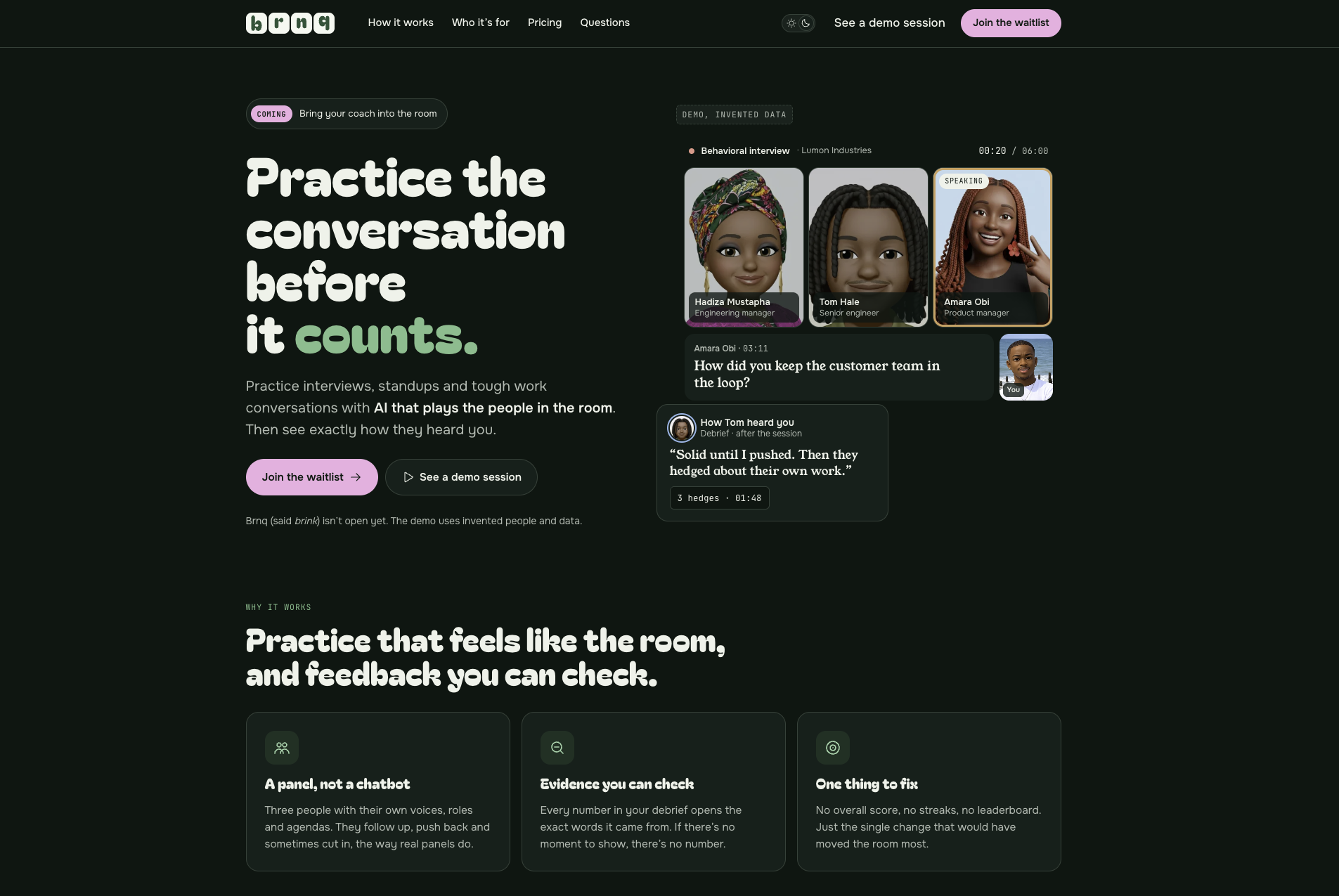
Brnq (said brink) is a practice room for the conversations that decide careers: the interview, the standup, telling a senior leader no. You speak out loud to an AI panel that plays the people in the room. Each has a voice, a role and a goal they won't tell you. Then a debrief shows how each of them heard you, points at your exact words, and gives you one thing to fix. Built solo in Lagos, for African professionals in any field: a React prototype now, with a Go + Python backend designed contract-first for the stage after this one.
The problem
Hiring loops and promotion panels reward communication rules nobody writes down. Engineers grind coding practice for months and still fail the behavioral round — not for lack of substance, but because they never learned the unwritten rules, and never practised them under real pressure. The gap is widest for neurodivergent people and for anyone interviewing across cultures: a Lagos engineer facing a foreign panel that has never heard their accent.
Asked “Are you interviewing anywhere else?”, I wanted to be honest and I was anxious, so I said “No, I really like this company.” Later I learned the conventional answer is closer to “I'm exploring a few opportunities, but this role is my priority.” I didn't lack substance. I lacked the unwritten rule, and nerves took away my ability to edit myself in the moment.
The insight that shapes everything
What you meant → what you said → how they heard it → what happened next. Brnq works on the gaps between those steps. It never teaches “the correct sentence” — it shows how a particular audience is likely to hear you, and you decide what to change. A good answer to “tell me about yourself” is different for a startup founder, a Big Tech engineering manager and a Lagos recruiter.
The hard problem isn't orchestrating AI agents. It's making a score you can trust. Most of the architecture exists to answer one question: why should I believe this number?
The rule everything follows from
Real examples of these rules biting during the build:
- ▸ The design showed “Hedges: 0” in the calm part of a session. A zero count has no moment to point at, so the debrief shows a dash instead.
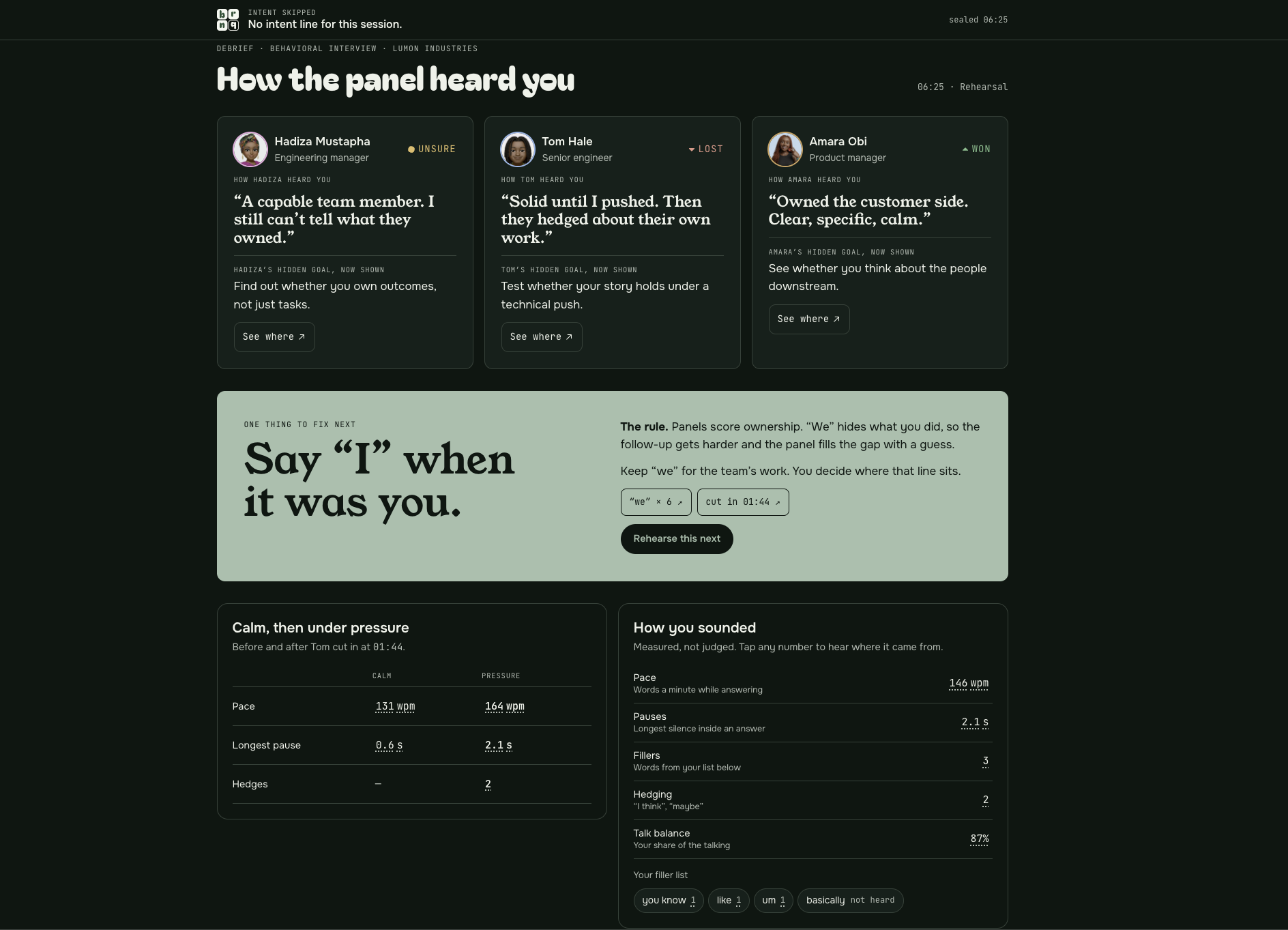
- ▸ A filler word on your list that you never said reads “not heard”, never “0”.
- ▸ The design counted “rising ends” — a voice pattern — as hedging. Dropped: it infers confidence from the voice and varies with accent, so it broke two rules at once.
- ▸ The design's demo said 78% talk balance. Recomputed from the example's own turn timings, it came to 87%, and the code was corrected to the honest number.
The demo, walked through
Everything below runs on scripted, invented data — labelled “Demo, invented data” on every screen. The fictional company is “Lumon Industries”, a small nod to Severance; the personas (Hadiza Mustapha, Tom Hale, Amara Obi, and coach Ada Okafor) are invented too.
Landing
The pitch, how it works, who it's for, pricing, FAQ, waitlist.
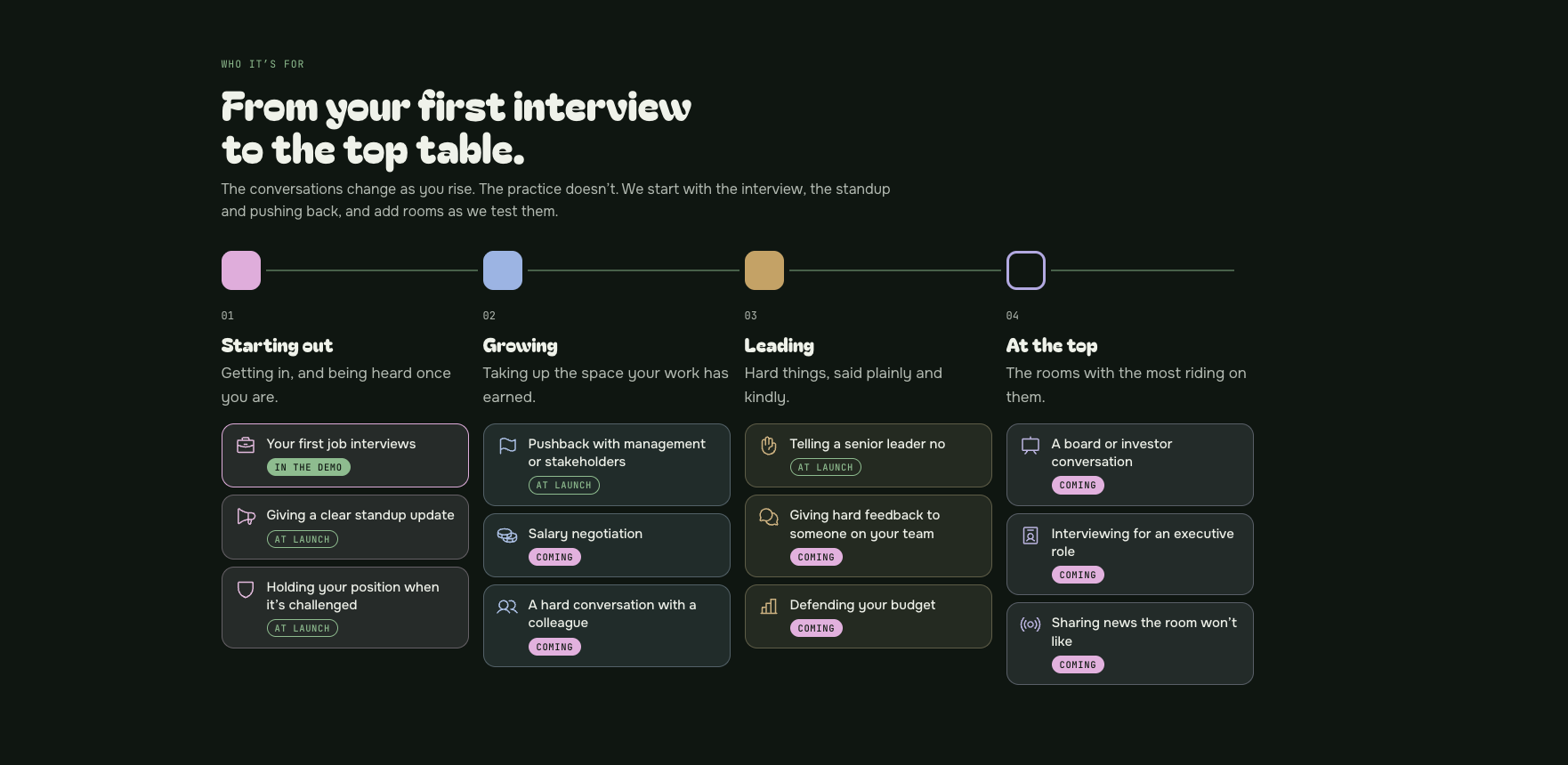
Who it's for
The conversations change as you rise; the practice doesn't. Four career stages, from your first job interview to a board conversation. The interview is in the demo; the standup, pushing back and telling a senior leader no come at launch; the rest are added as they're tested.
Pricing
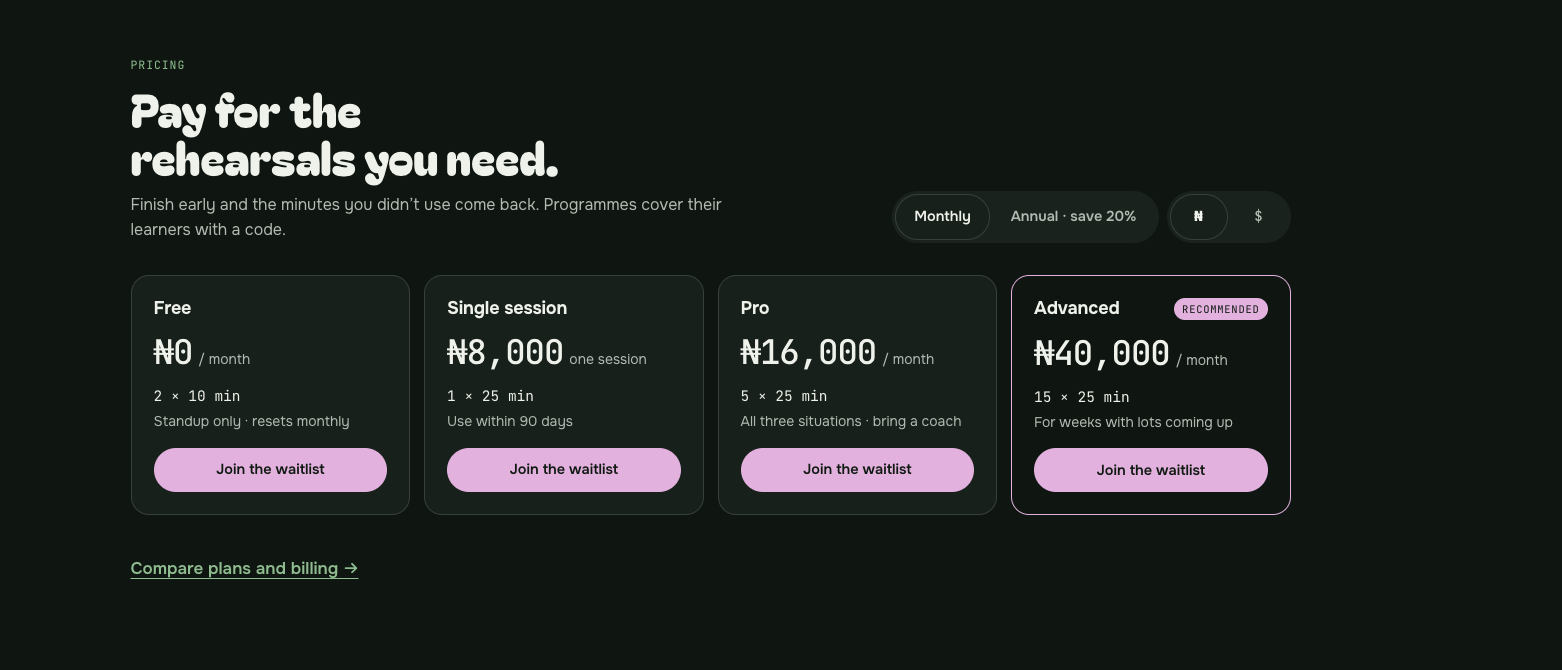
Sold as sessions, metered as minutes. Annual plans release sessions monthly rather than all at once — for many Nigerian users the real barrier is a large one-off dollar charge, not the sticker price.
Set-up
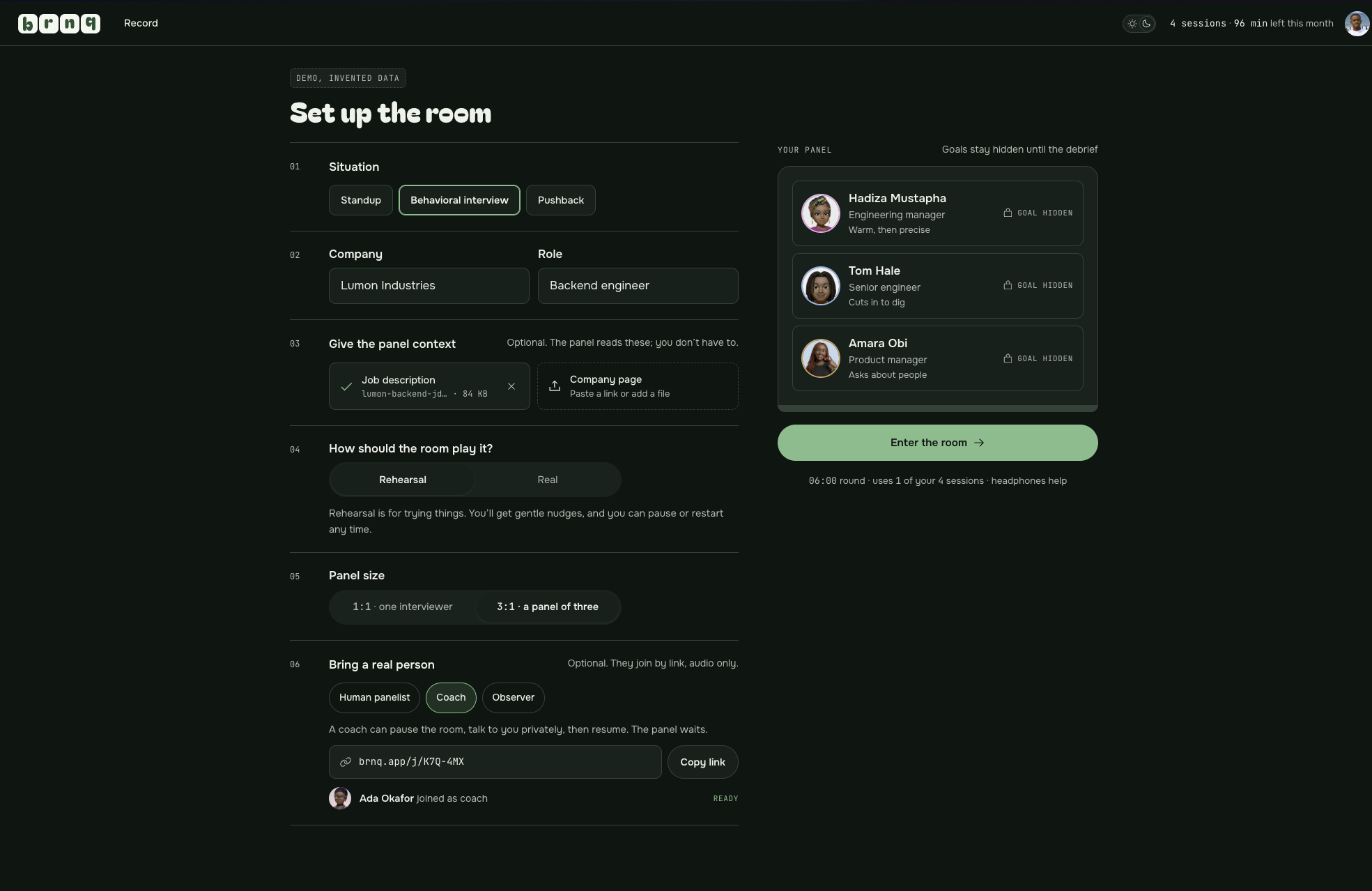
Situation, company and role, optional context (a job description, kept in memory and never uploaded), Rehearsal or Real mode, panel size, and an invite for a real human — a panelist, a coach, or an observer. The panel's goals stay hidden until the debrief.
The room
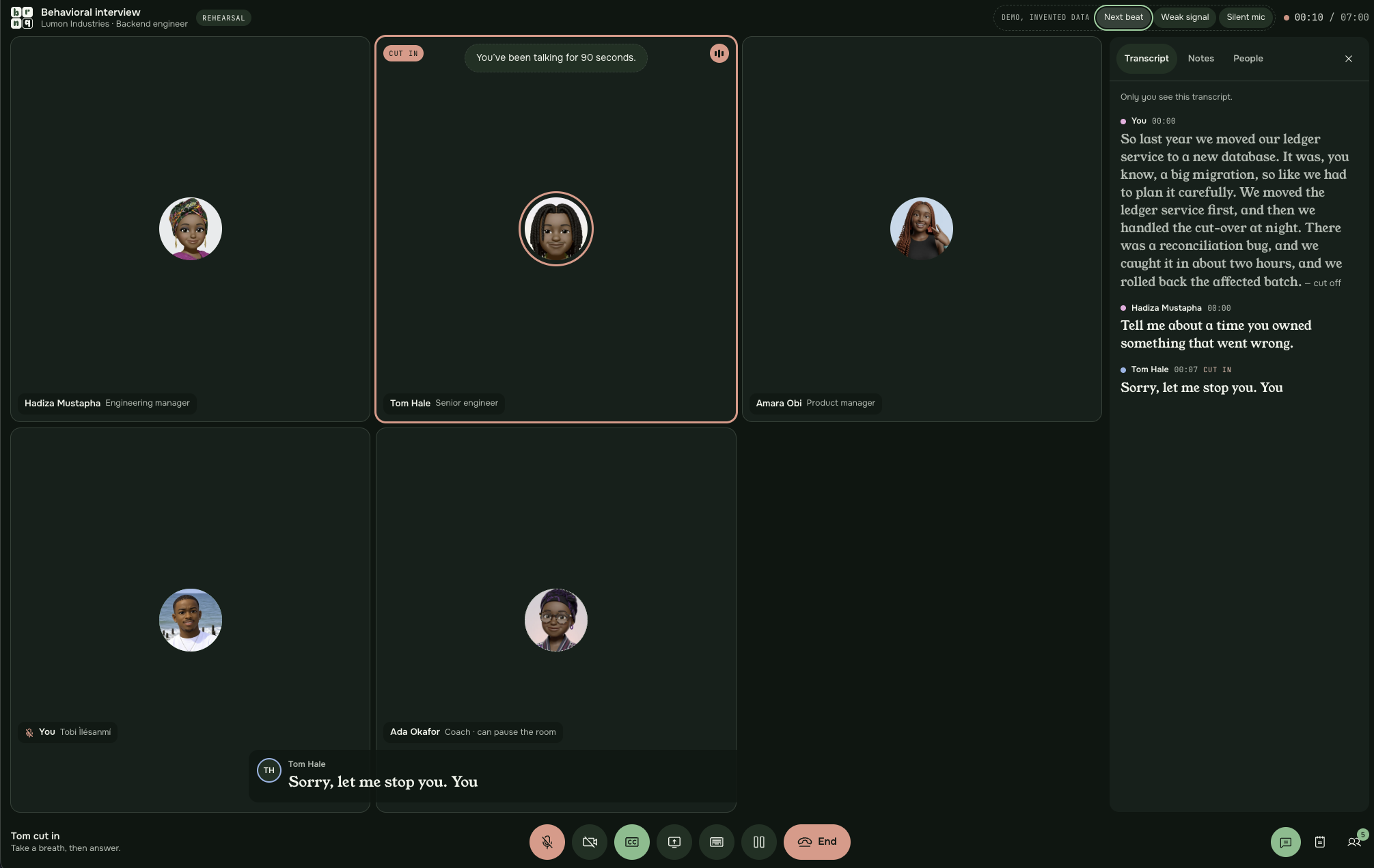
Persona tiles with speaking rings, live captions, a transcript/notes/people panel, and a panelist cutting in mid-answer. Here Tom Hale cuts in at 00:07 — “Sorry, let me stop you...” — because you've been talking for 90 seconds, and the room coaches you through it: “Tom cut in. Take a breath, then answer.” Ada Okafor sits in as the invited coach, who can pause the room at any point.
Intent
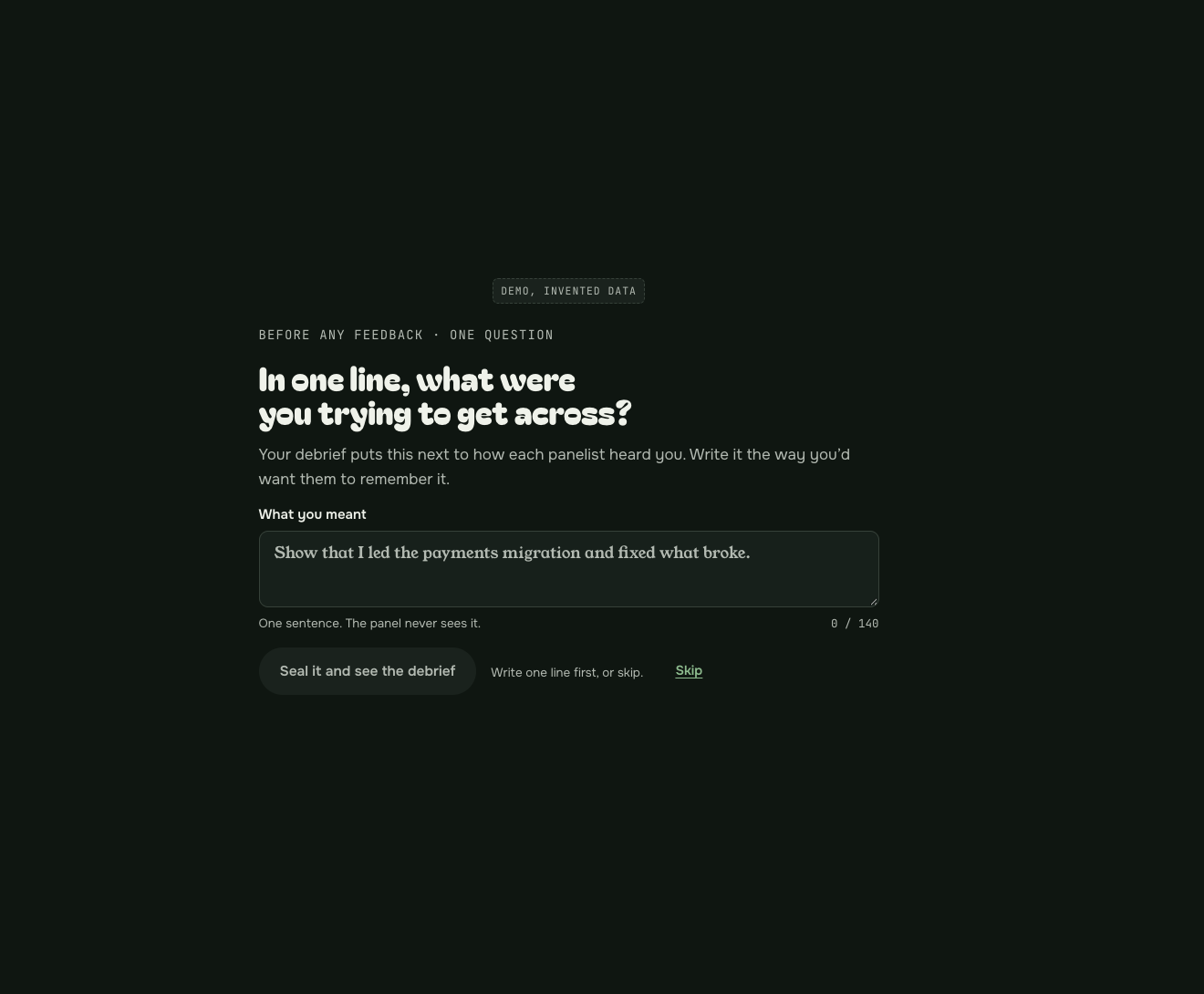
One line, up to 140 characters, sealed before any feedback. The panel never sees it — it's there to compare against how you were heard.
The debrief
Each panelist's read beside your intent, their hidden goal now revealed, one thing to fix, calm-versus-under-pressure measures, and the filler list. Every number opens the exact moment in the transcript it came from.
How success is measured
Each stage has a number to hit before the next one starts.
Clickable prototype on invented data
10 of 15 people point at the debrief, unprompted, as the useful part
One scenario with real voice, real grading, real storage, an eval harness and a cost meter
Noise band measured; 19 of 20 spot checks land on the right evidence
Individuals can pay; one programme runs a free cohort
100 paid sessions from strangers; 25% buy again within 30 days
Built with
What's real, and what isn't yet
- ▸ The web app is real. A genuine React foundation, not throwaway mockups — the intelligence layer and the platform plug in later through ports, without the screens changing.
- ▸ The panel in the demo is scripted, not live AI. Real voices and speech recognition, real grading, accounts, payments and the backend services are designed and contracted, not built — that starts at S1.
- ▸ No outcome claims. Brnq doesn't claim to improve interview outcomes. That's what the stage gates above will measure, not what the prototype asserts.
- ▸ It's a trainer, not a hiring or assessment tool — programmes see aggregates only, and a learner shares one session by choice, revocable.